
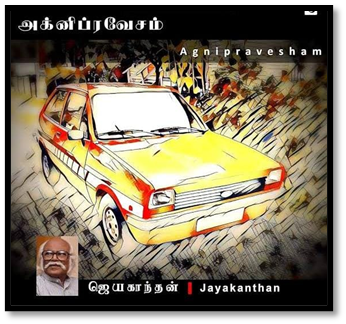
“Agni Pravesam” (meaning “Entrance of Fire” or “Trial by Fire”) is a landmark Tamil short story written by acclaimed author Jayakanthan. Published in the 1960s, it caused a major stir in Tamil literature due to its direct, non-judgmental approach to the themes of female sexuality, patriarchal norms, and the rigid definition of chastity in traditional society.
Here is an elaborate overview of the story:
1. Context and Plot Summary
• The Incident: On a stormy, rainy day, a young, naive college girl named Ganga is picked up in a car by a stranger (a rich young man). He seduces her and forces her into sexual intercourse.
• The Aftermath: Following the assault, the man drops her off on her street. Confused, traumatized, and slow to comprehend the gravity of what has happened, the girl returns home.
• The Mother’s Reaction: When the girl reaches home, the mother realizes her daughter has been “dishonored”. However, instead of weeping, blaming her daughter, or initiating a public scandal, the mother silently takes a bucket of water and pours it over her daughter’s head, washing her.
• The “Agni Pravesam” (Trial by Fire): The mother treats this bath as a cleansing ritual—a symbolic Agni Pravesam (a reference to Sita’s purification by fire in the Ramayana)—purifying her daughter from the sin committed against her. She asks her daughter to forget the incident and resume her life as if nothing happened.
2. Core Themes and Analysis
• Challenging Societal Norms: The story challenges the traditional patriarchal notion that a woman’s worth is solely tied to her virginity.
• Redefining Chastity: Jayakanthan suggests that forced sexual assault does not make a woman “unclean” or “fallen.” The mother’s act implies that chastity is a matter of the mind and spirit, not just the physical body.
• The Mother as an Agent of Change: The mother in this story defies the expected role of a conservative, outraged matriarch. Instead, she is pragmatic, protective, and progressive, refusing to let her daughter become a societal outcast.
• Patriarchal Oppression: The story highlights how women are often trapped by rigid cultural norms and gender inequality.
3. Controversy and Evolution
“Agni Pravesam” was highly controversial upon release. Many readers and critics at the time found the mother’s acceptance of the situation shocking and demanded a more “conventional” (punitive) ending.
In response to the backlash, and to explore the psychological aftermath of the trauma more deeply, Jayakanthan expanded the premise into a full-length novel, Sila Nerangalil Sila Manithargal (“Some People in Some Situations”).
• In the novel, the narrative expands to show the long-term psychological, social, and economic consequences for Ganga.
• It later received a sequel, Gangai Enge Pogiral (“Where is the Ganges Going?”), where the protagonist continues to struggle with her past.
4. Literary Significance
• Bold Narrative: Jayakanthan is known for his raw, realistic portrayal of human emotions and social issues. “Agni Pravesam” is a prime example of his daring style.
• Psychological Depth: The story focuses on the silent, internal trauma of the girl and the stoic, resolute nature of the mother, rather than focusing on the act of violence itself.
Agni Pravesam remains a seminal work in Tamil literature for its courageous critique of social hypocrisy.